
Beyond analysis: let’s teach business students to act


Created in partnership with

Created in partnership with
You may also like
Popular resources
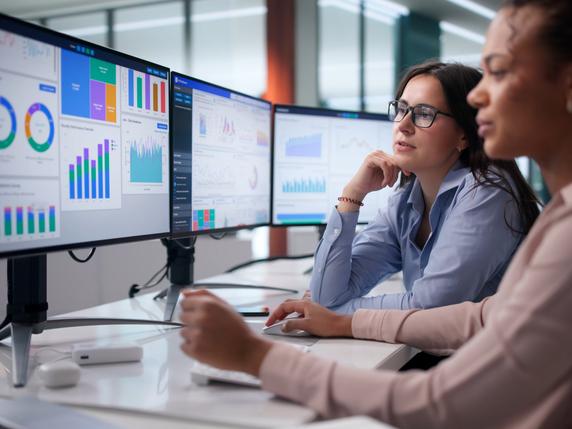
Dashboards pervade business contexts. Leaders use them to track finance and logistics. Some even use dashboards to monitor other dashboards. Yet many leaders focus on the rear-view mirror, reviewing what happened rather than anticipating what lies ahead.
We have noticed a pattern over our combined 40-plus years’ experience in business transformation: academically accomplished postgraduate students can struggle with execution. They understand the platforms but may lack the judgement to translate insights into action. They have been taught to explain, not necessarily to decide. This is a problem, because in digital transformation, reacting too late can mean missed opportunities. So, we changed our approach. Now, we challenge our students not only to report on data but to anticipate developments.
To do this, we partnered with Recurso Confiable, a Mexican logistics company, to co-design “volatility labs” in which students simulated route failures, supplier shocks and weather-related disruptions. They developed intelligent agents using Python and machine learning and used their business judgement to anticipate and respond to potential disruptions. These exercises changed the way students think.
Develop students’ foresight
Many postgraduate students begin their courses with the technical skills needed to create dashboards. In our experience, however, they may need further opportunities to develop the confidence and judgement required to lead with data. This is where observability becomes essential: understanding how systems behave through the signals they generate and using those insights to anticipate disruptions and inform decisions. Educators must move beyond tools and frameworks to cultivate strategic reasoning amid uncertainty.
We challenge our students to think two or three moves ahead, question their assumptions and stress-test scenarios. This requires teaching them to operate deliberately under ambiguity, not in spite of it.
We begin with structured data cleaning using Python’s pandas and NumPy libraries to establish a foundation for data integrity. Students also develop supervised machine learning models, such as regression and decision trees, trained on historical, labelled data to predict outcomes such as transportation delays or delivery failures. They also explore unsupervised methods, such as clustering and anomaly detection, to identify patterns and unusual behaviour without predefined outcomes.
By using cloud platforms, students test how these models perform under realistic business conditions: unexpected disruptions that challenge predictive accuracy, increasing data volumes that test scalability and processing delays that can make predictions less useful if they arrive too late. The objective is not simply to build sophisticated models but to develop the judgement needed to interpret results, anticipate consequences and make timely business decisions.
The emphasis shifts from explaining what happened to anticipating what could happen next. We train students to develop intelligent agents: AI-powered software systems that analyse incoming data, identify patterns and support decisions based on predefined objectives. In transportation and supply chain environments, these agents can detect early warning signals, prioritise critical variables and recommend corrective actions before disruptions escalate into operational failures. We want to strengthen students’ ability to anticipate risks and respond proactively.
Dashboards become the final step, not the starting point. Students use tools such as Microsoft Power BI and Tableau to present not just data but forward-looking insights, with each chart addressing a strategic question. The design priority is to enable timely, high-quality decisions in boardrooms, not just polished presentations in classrooms.
Cultivate strategic thinking
We do not aim to train engineers. We are cultivating strategic thinkers who can frame decisions with evidence, challenge flawed assumptions and guide organisations through complexity.
Effective observability combines analytical modelling, real-time data processing and human reasoning. It evolves with business needs and can strengthen leadership judgement.
- Spotlight guide: Get your students workplace-ready
- Tried and tested ways to teach your students soft skills
- Strategies to train students in three transferable skills wanted by employers
Why partnerships matter in postgraduate business education
Industry-academia partnerships enable students to apply analytical concepts to real-world business challenges by connecting theoretical knowledge, practical experience and strategic decision-making.
Students gain technical skills and develop contextual intelligence: the ability to apply theory to complex business problems. They also experience how artificial intelligence and observability can support, rather than replace, human decision-making.
Observability relies on sound data practices, including data cleaning, structuring time-series records and selection of analytical methods appropriate to the problem.
Postgraduate students must be able to:
- clean datasets using pandas and NumPy
- identify outliers and address missing data
- apply machine learning models on cloud platforms
- design dashboards using commercially available tools.
The goal should be to develop the analytical literacy needed to ask informed questions and evaluate intelligent platforms.
Postgraduate business education must evolve
Analytics alone are not enough. We need foresight and action. That begins with classrooms that prepare students to navigate uncertainty.
Observability involves using the signals a system produces to form conclusions about its internal state. In supply chains, this can improve understanding of operational disruptions. Monitoring tracks predefined indicators, while observability helps explain emerging system behaviour. When combined with machine learning and real-time data, observability can help students predict potential disruptions. Climate-related events, geopolitical developments and digital complexity increase the need for timely, informed responses.
When we incorporate AI and machine learning into observability practices, they can enable predictive diagnostics. Relevant questions include: “Can we explain disruptions in real time?” and “Can we recognise weak signals before they become critical?”
Effective observability can reduce investigation time, improve reliability and support better service outcomes. It also requires cultural change: moving beyond traditional reporting towards informed, adaptive decision-making.
Even the most sophisticated dashboard cannot, by itself, prevent the next bottleneck. A well-prepared graduate, however, may be able to anticipate it and help an organisation respond. In an uncertain world, the goal is not simply to analyse data but to think several moves ahead.
José Ignacio Sordo Galarza and Astrid Xiomara Rodríguez Castelblanco are associate professors of digital transformation and data analytics at Tecnológico de Monterrey, Mexico.
If you would like advice and insight from academics and university staff delivered direct to your inbox each week, sign up for the Campus newsletter.
