Staff fear ‘catastrophic’ impact of Nottingham ‘consolidation’

Increases to staff-student ratios could send university into a ‘death spiral’, says union leader as vice-chancellor insists institution must act now

Published on
December 23, 2025
Last updated
December 23, 2025
Source: iStock/Guida Simoes

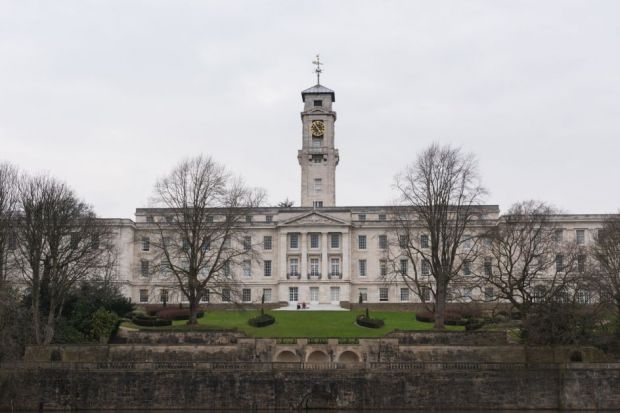
Staff at the University of Nottingham fear that planned course closures and changes to staff-student ratios could damage the university’s international standing and create “impossible” workloads.

The institution currently has between 15 and 16 students for every staff member but wants to increase this to between 18 and 22 students, according to a “case for change” document recently shared with employees.

This also outlines plans to “consolidate” the university from five faculties to three colleges by 2029.

It comes after Nottingham announced in November plans to suspend recruitment on to 42 courses which would see its music and languages departments shut down, as well as programmes in nursing, education, microbiology and agriculture affected.

ADVERTISEMENT

The university’s vice-chancellor Jane Norman told Times Higher Education that she recognised it was a “difficult time for our university community” and “we are listening to concerns and questions raised by staff, students and trade unions”.

“However, the government has been very clear that it expects universities to manage their own finances and focus on areas of strength, and we need to take action now to ensure the University of Nottingham remains a world-leading institution long into the future,” said Norman.

ADVERTISEMENT

The institution’s University and College Union (UCU) branch believes the plans could eventually result in up to 600 job loses – on top of 300 staff members who have already left Nottingham in recent years – and said the results would be “catastrophic”.

The university’s transformation programme does not outline any staff cuts but does say it will address the “financial sustainability” of “academic staff allocation” through the staff-student ratio changes. In November it committed to making no compulsory redundancies before 31 October 2026.

Nick Clare, secretary of the UCU branch, said “morale has never been lower” in his 10 years at the university. 

“Things were difficult through Covid but there was a sense of pulling together through it. This is very different. People are looking for work elsewhere. It’s not a happy place at the moment.”

Clare said he feared the changes could create a “death spiral” of higher workloads, falling student satisfaction, fewer student applications and weakened league table results.

Union members have so far taken 25 days of strike action this academic year alone, and a new trade dispute it announced last week could pave the way for further strike action in the new year.

ADVERTISEMENT

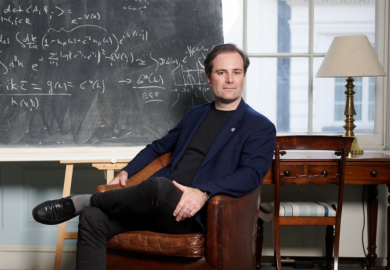
Philip Moriarty, professor of physics at Nottingham, said changes to staff-student ratios “make no sense at all”, and noted physics currently has a ratio of around 11:1. If this increased to 18 students per staff member, he said as many as 20 academics could be cut from the department of 55, if the plans were to go ahead.

“I don’t think I’m being dramatic when I say this could mean the end of the university,” he said, adding the remaining workloads would be “impossible to manage”.

ADVERTISEMENT

“How does driving our staff-student ratio in entirely the wrong direction help students? It doesn’t, and it’s purely about cost cutting, and it’s purely about numbers on a spreadsheet,” he said.

The transformation plan also includes targets to achieve a surplus of between 3.7 and 9 per cent, with the latter figure considered high by sector financial experts. Moriarty said the target had “blindsided” staff, and said it is “out of line with every other university in the UK”.

Lopa Leach, the branch president, said staff have been left devastated ahead of the Christmas period, with staff also recently finding out that promotions have been paused.

She added that the proposals are “fiscally driven” and said heightened workloads put academics’ research capacities at risk.

Norman said the university was “in a period of engagement with our whole community which will assess the impacts of current proposals and provide the space to explore other options”.

“We continue to have regular dialogue with our trade union colleagues as part of our joint recognition agreement and would encourage them to submit their formal counterproposals as part of our engagement process. We are providing support for staff, students and stakeholders on the development of viable counterproposals, which will inform our final business case.” 

ADVERTISEMENT

juliette.rowsell@timeshighereducation.com

Register to continue

Why register?

  • Registration is free and only takes a moment
  • Once registered, you can read 3 articles a month
  • Sign up for our newsletter
Please
or
to read this article.

Related articles

Reader's comments (12)

I don't think an SSR of 1:18 or 22 is that high, historically at least. It was only when the SSR started featuring in the league tables as a crucial statistic that HEIs decided to try and drive it down to improve their rankings often deploying some problematic expedients. I remember being an a Dept with an SSR of 1:17 and we were criticized for under recruiting by a RG external reviewer who said SSR was 1:24 in his School. Maybe there are other factors to consider, but it's hardly a "death-spiral" scenario per se and should not lead to "impossible workloads" provided it is managed carefully (and maybe they are not competent to do so). It will mean higher class sizes of course. But if you want to hang on to the small group teaching in a mass HE system, then you will have issues of course.
Teaching related administration requirements have exploded in the last 25 years and the workloads are not comparable
Gosh - a U outside of the O&C 1:12 SSR bubble which has a low SSR (really 11;1 in one department?) is indeed rare. SSRs have crept up from c1;12 almost everywhere in the Halcyon Days of the 60s & 70s to say 1;17/18 or even 1:20+ as a result of ‘massification’ in the 90s. And doubtless are now worsening at some of the Russellers as they steal new students from down the hierarchy in the last couple of admissions rounds. The pain of worsening SSRs is, of course, felt by academics made redundant as well as by those left with more Ss to look after - and by the Ss themselves who experience the over-crowded seminars as what is meant to be ‘higher’ about HE (the opportunity for fully engaging in academic discourse) is eroded. Thus UK shifts from its generous SSRs towards international norms?
Exactly, and colleagues will have to cut their cloth ... The thing is that many want to hang onto what is called the "sub Oxbridge" tuition model that has been discussed in several previous THES pieces. It does look like some of those here have been living in the past (and would we could). But it's also hard when fees are rising and the students paying more and they see that they are getting less not moire. But then again, someone has to pay for those astronomic VC salaries and generous annual bonuses I guess?
Tho' the pain is greater for this who are made redundant with mortgages and children, possibly, to support? No annual bonus for them. So it's a lot worse for them than those who keep their jobs in my view. This "will hurt me more than it hurts you" as they say.
"...... physics currently has a ratio of around 11:1. If this increased to 18 students per staff member, he said as many as 20 academics could be cut from the department of 55, if the plans were to go ahead." Hmmmmmm! A dept. of 55 with an SSR 11:1? There must be some really phenomenal research income to support that number surely. Personally, I would kept that stat quiet if I were making the case against cuts.
Yes I was thinking the same thing.
“I don’t think I’m being dramatic when I say this could mean the end of the university,” he said, adding the remaining workloads would be “impossible to manage”. Actually, we think you are.
The whole of UK HE is being bought down by a bloated level of middle management, often distant from core activities and carrying grandiose titles but delivering next to nothing except box ticking “initiatives” and burden on those doing the actual work. It is shocking how the sector has become so badly infected in no more than a decade.
Fully endorse this " The whole of UK HE is being bought down by a bloated level of middle management, often distant from core activities and carrying grandiose titles but delivering next to nothing except box ticking “initiatives” and burden on those doing the actual work. It is shocking how the sector has become so badly infected in no more than a decade." Furthermore we need to start sacking many of the useless bloated middle and upper management a.s.a.p.
Well there is something to be said for middle management, they tend to get all the awful stuff to deal with and are caught between a bolshy staff (whom you would not trust to run the local sweetie shop) and a remote and arrogant upper management (whom you would not trust to run the local sweetie shop) and actually have very little power, which seems to diminish over time as the system became more centralized with more useless and expensive PVCs. Usually, tho not always I admit, in my experience the middle management were pretty decent dutiful types, trying to do an almost impossible job for very little thanks, managing conflicting imperatives (almost always crack-brained) and dealing with some of the most difficult (and often entirely useless) people imaginable, and the financial rewards were never that great for taking on the role, usually, just a modest honorarium while you did the job though often just expected to do it. I was very glad whenI finally got out of the system I was lucky enough to do on very good terms and I now tend to think, "a plague o' both your houses". As it seems from this piece, the staff and management at that place seem thoroughly to deserve each other and I wish them both the best of luck with their "death spiral" or "brave new world". Merry Xmas to one and all and Best Wishes for the New Year!!
I agree, it's the middle management that often do most of the work, take most of the flak from below and above. The notion that one's academic colleagues are great administrators etc is very generous and many of them shirk and avoid the admin and management responsibilities that they should shoulder like the rest and often live in some idea academic past often ;located hazily in the 1970s that never really existed anyway. I think the chap who's complaining about the possibility of an 1:18 SSR (which I would love to have), must be an example of that.

Sponsored

Featured jobs

See all jobs
ADVERTISEMENT