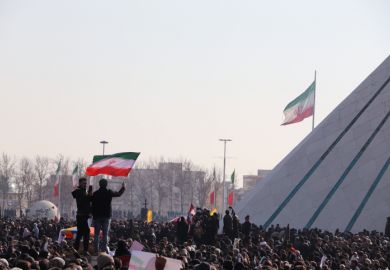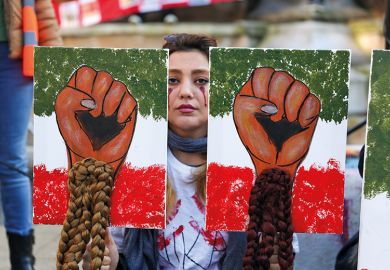
An Iranian student has been shot dead during anti-government demonstrations in Tehran, as universities continue to face disruption amid an ever more restrictive regime response to the protests.
Rubina Aminian, who studied textile and fashion design at Shariati College in the capital, was killed on 8 January after leaving her campus to join protests, according to the Norway-based organisation Iran Human Rights. Sources close to the 23-year-old’s family told the group that she was shot in the head at close range.
Aminian’s relatives travelled from their home in Kermanshah province to Tehran to identify her body, which was among scores of others.
According to Iran Human Rights, they were confronted with numerous corpses of young protesters before finally locating her.
“It wasn’t just my daughter; I saw hundreds of bodies with my own eyes,” Aminian’s mother told the group.
After retrieving her body, the family returned home but found their house surrounded by intelligence forces and were reportedly barred from holding a funeral there. They were ultimately forced to bury her beside a road between the city of Kermanshah and nearby Kamyaran.
Aminian was described as a vibrant young woman who had been passionate about her studies and her future.
Her death came amid one of the most sustained periods of dissent the Islamic Republic has faced in years.
The US-based Human Rights Activists News Agency estimates that at least 538 people have been killed in the unrest and more than 10,600 arrested, although restrictions on communication make exact figures difficult to confirm.
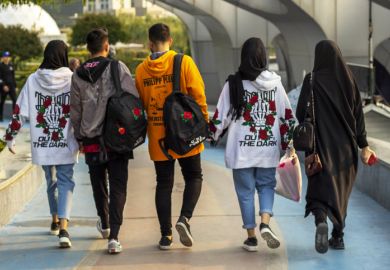
In recent weeks, several Iranian universities have suspended in-person teaching and moved examinations online as authorities seek to limit campus gatherings.
During earlier protest waves, closures and remote learning measures were used to disperse student demonstrations and curtail assemblies.
Scholars have warned that these responses risk further disrupting academic life and could have lasting consequences for teaching, research and campus autonomy.
Nasim Basiri, an Iranian scholar who is currently a visiting assistant professor at the University of Connecticut, told Times Higher Education: “Higher education has become both a battleground and a barometer of social change at the moment, where academic freedom, gender equity and political expression are actively contested.
“The ongoing repression in universities undermines not only immediate student welfare but also long-term intellectual and social progress, especially for women scholars and students.”
Student activism has also drawn the attention of security forces.
Rights groups have reported arrests and detentions of students at demonstrations in Tehran and other cities, highlighting the risks faced by young people who take part.
The protests began in late December amid economic grievances and calls for political change. The movement has since expanded into a broader challenge to the regime’s authority.
Iranian authorities have responded with force, including using live ammunition and mass arrests, as well as imposing internet outages and communication restrictions.
Register to continue
Why register?
- Registration is free and only takes a moment
- Once registered, you can read 3 articles a month
- Sign up for our newsletter
Subscribe
Or subscribe for unlimited access to:
- Unlimited access to news, views, insights & reviews
- Digital editions
- Digital access to THE’s university and college rankings analysis
Already registered or a current subscriber?