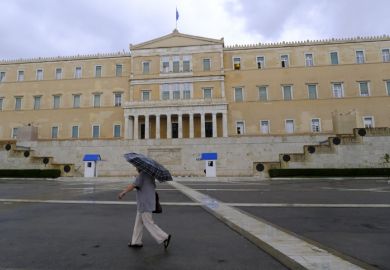
Greek academics have backed the country’s decision to remove about 300,000 inactive students from public universities, calling it long overdue and a necessary measure to modernise a system that allowed students to remain enrolled for years without graduating.
The sweeping reform affects nearly half the country’s student population and marks an end to a decades-long practice that allowed extended enrolment to support lifelong learning and breaks for work.
Dionissios Mantzavinos, vice-rector for strategic internationalisation at the University of Patras, described the measure as “very positive”. He said that about 18,000 of the institution’s body of 34,000 students had been removed from the roll.
“This had to happen at some point,” he said. “Nowhere else in the world do students who fail to complete their studies within a fixed period of time remain in the system for so long. There were some students who registered 15 to 16 years ago.”
Mantzavinos said that the Greek education system was “very student-friendly”, which had made it difficult to implement such a policy in the past. There had been some backlash in just two or three of the university’s 71 departments “from a small number of colleagues”, he added, but stressed that the policy would improve staff-to-student ratios and help raise the university’s international standing by bringing it closer to European norms.
On 2 January Greece’s education ministry revealed that 308,605 students admitted to state-run universities’ four-year degree programmes before 2017 had been removed from the records. “Student status is not valid for life in any modern European university,” education minister Sofia Zacharaki said.
One of the reasons so many people, known as “eternal” or “perpetual” students, could remain enrolled for years is that Greek public universities do not charge undergraduate tuition fees.
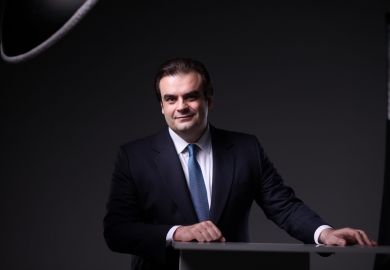
Kevin Featherstone, emeritus professor at the London School of Economics and former director of the Hellenic Observatory, called the move “long overdue”. Very few academics in Greece would object to it, he said.
“It’s been talked about for decades,” he said. “Most professors have supported this for many, many years but it’s been the power of student protests within universities which has prevented successive governments from moving ahead.”
Featherstone said that clearing inactive students could be a sign that Athens was willing to take broader steps to reform higher education. “It’s a rare indicator of the government’s ability to move ahead with liberalising reforms,” he said, adding that more controversial topics, such as allowing private universities, remain politically sensitive in Greece.
He said cutting down on the number of students would also help professors with university planning and improve overall efficiency.
“There are thousands of Greek academics who work in UK universities because they have chosen to escape from a dysfunctional university system at home,” he added.
Not all academics are convinced that removing inactive students will fully address the issue of eternal students. Loukas Vlahos, physics professor at Aristotle University of Thessaloniki, emphasised that removing such students addresses the symptom but not the cause.
“Now that the issue of so-called perpetual students has been addressed, it is reasonable to ask the next question: what measures will university leadership and the [education] ministry take to ensure that the same phenomenon does not reappear in a few years?” he said.
Vlahos stressed that other institutional practices have contributed to prolonged enrolment, including allowing students to take exams repeatedly without providing structured support, weak enforcement of prerequisites and study pathways that allow students to progress without mastering core courses.
“Only about 40 per cent of students complete four-year programmes within six years,” he said. “If we want a real solution, we have to fix the mechanisms that create perpetual students in the first place.”
Register to continue
Why register?
- Registration is free and only takes a moment
- Once registered, you can read 3 articles a month
- Sign up for our newsletter
Subscribe
Or subscribe for unlimited access to:
- Unlimited access to news, views, insights & reviews
- Digital editions
- Digital access to THE’s university and college rankings analysis
Already registered or a current subscriber?