Efforts to get university workers back on to campus five days a week could prove less divisive in Asia, where working from home has generally failed to take root in the same way it has done in the West.
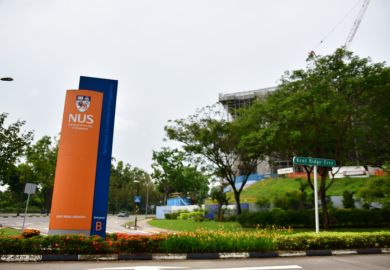
The National University of Singapore (NUS) recently ordered all professional services staff back to campus full-time in a move that would probably have caused uproar in countries such as the UK, where workers have held strikes over proposals to increase office days from two to three.
But, although some institutions in Asia have experimented with flexible arrangements that reflect changing expectations among younger staff and new modes of teaching and research, working from campus generally prevails.
In Malaysia, Francois Therin, deputy vice-chancellor (research and enterprise) at the University of Cyberjaya, said that after a brief period of pandemic-induced remote working, most universities have reverted to being in the office full-time.
“Universities in Malaysia, at least for the private ones...did what most other private companies have been doing all over the world, which is going back to the office basically five days a week,” he said.
He added that “even for academics, because Malaysia still has a strong culture of people being at the office in general”, the “slack during Covid time and post-Covid” had now disappeared. Some universities are so strict that they even monitor the time staff spend at work, he noted.
The main reasons for this, he said, were “culture, definitely...collaboration inside faculties and between faculties”, and “student experience, making sure that when students want to meet with their faculty, the faculty is around”.
Therin also saw a generational divide: “Gen Z...would not mind if one or two days per week they were working from home. In fact, they would even consider it as being more productive.”
In Japan, Sayaka Oki, a professor at the University of Tokyo’s Graduate School of Education, said professional services staff work mainly on campus, with fixed hours from 9am to 5pm, while academics operate under a “discretionary labour system” allowing greater flexibility. Hybrid work is possible for both but administrative staff must declare homeworking in advance.
She said the policy predated the pandemic but was “rarely practised for exceptional cases” before Covid-19 expanded its use. Those who do work at home do so for diversity, equity and inclusion reasons, such as being a caregiver or being disabled.
In Japan overall, remote working rates remain below 20 per cent, with home-based work accounting for more than 90 per cent of such arrangements and contributing only about 7 per cent to total working practices, according to data published last year by the Research Institute of Economy, Trade and Industry.
Another study from the Japan Institute for Labour Policy and Training found that even during the pandemic year of 2020, just 29 per cent of employees worked from home, although this was significantly up from 5.5 per cent pre-pandemic.
In South Korea, Jae-Eun Jon, associate professor at Hankuk University of Foreign Studies in Seoul, said her university had no formal work-from-home policy but she noted that some national universities had adopted limited measures.
The country’s low figures for remote work reflect this reality: a 2023 global survey led by Stanford University’s WFH Research institute ranked South Korea bottom among 40 major economies, with employees averaging just 0.5 days of home work per week, compared with 0.7 in Japan and 0.6 in China.
In India, Narender Thakur, from Dr Bhim Rao Ambedkar College at the University of Delhi, said his institution does not currently have a formal homeworking policy either.
However, in Vietnam, Pham Hung Hiep, director of the REK Institute for Research on Education and Knowledge Transfer, said working from home had “become very popular in academia in Vietnam in general and in my university in particular”.
At his institute, staff are required to be present “only two and a half days per week. The rest of the week, they do what they want.”
Pham said most staff welcomed the flexibility: “Everybody loves it because they have more freedom, more autonomy.”
Although the arrangement had become embedded in post-pandemic practice, he acknowledged some drawbacks: “Sometimes it’s a little difficult to monitor the performance of my staff, and sometimes I have difficulty communicating with them.”
Register to continue
Why register?
- Registration is free and only takes a moment
- Once registered, you can read 3 articles a month
- Sign up for our newsletter
Subscribe
Or subscribe for unlimited access to:
- Unlimited access to news, views, insights & reviews
- Digital editions
- Digital access to THE’s university and college rankings analysis
Already registered or a current subscriber?