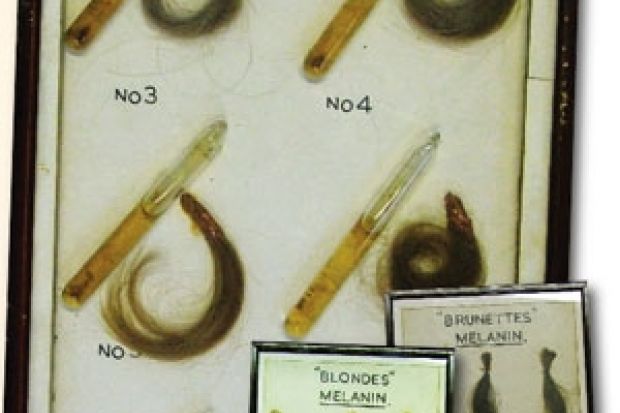
These hair samples may look as if they come from the collection of a serial killer, but they were prepared by one of the major figures in the development of the University of Dundee's renowned programme of life science research.
Robert Percival Cook (1906-89), an Australian academic who had previously worked at the universities of London and Cambridge, joined Dundee's physiology department in 1940.
He soon developed a strong focus on biochemistry, eventually becoming head of a separate biochemistry department in 1966 and the university's first professor of biochemistry in 1972.
Professor Cook made his name with important research on cholesterol, some of which involved force-feeding himself with omelettes.
He later turned his attention to colour and created these hair samples for use in teaching.
Carnoustie is a small town near Dundee that is most famous for its golf course. Cook's samples suggest that it was also noteworthy as a source of red hair.
The display now forms part of the University of Dundee Museum Collections, along with other examples of Cook's work.
Register to continue
Why register?
- Registration is free and only takes a moment
- Once registered, you can read 3 articles a month
- Sign up for our newsletter
Subscribe
Or subscribe for unlimited access to:
- Unlimited access to news, views, insights & reviews
- Digital editions
- Digital access to THE’s university and college rankings analysis
Already registered or a current subscriber?